The Wish We Live: Personal Relationships in the Heart of Service
 When I moved to Georgia almost 34 years ago, it didn’t take me long to become a country music fan. Seems unlikely for a hardcore rock and roller who grew up on the beach. But it happened (let me clarify that I do not mean the old time ‘twangy’ country music of the ‘50s and ‘60s; that doesn’t do it for me).
There’s a song that I especially fell in love with. It has touched millions of hearts over the years. It’s by the country music group Rascal Flatts called “My Wish.” A song so simple and yet so profound that it transcends genre, age, and circumstance. It speaks of wishes. Not the frivolous desires we sometimes chase, but the deep, sacred longings we hold for those we love. When I consider the work we do at the Society of St. Vincent de Paul, I find myself returning again and again to those verses, to that chorus that captures something essential about what it means to serve another human being.
The songwriter penned those words thinking of his youngest daughter. He wanted her to know, in a world that felt overwhelming and complex, that someone was thinking of her. Someone cared about where she was going. Someone believed in her. That simple act of holding another person in your heart and expressing that devotion; that is the essence of what I see reflected in every Vincentian I meet.
Listen to the heart of the song’s message: the wish that “days come easy, that moments pass slow, that dreams stay big and worries stay small.” Those aren’t material wishes. They’re wishes for peace, for hope, for the assurance that someone believes in you and wants good things for your life. This is precisely the work we do. Every single day.
You know, anyone can give things. Anyone can open a checkbook or drop off food or clothes, and those are wonderful, important acts of love. But what you as Vincentians have chosen to do is far more difficult and infinitely more sacred. You have chosen to ‘know’ people. You have chosen to see them. And in that seeing, in that genuine encounter, something holy happens.
Let me be honest with you, although you, no doubt, already know it. Service at its finest can be deeply uncomfortable. We want to help, yes, but we also want our helping to feel good, to feel efficient. We want to cross items off our list. What the Society of St. Vincent de Paul asks of you is harder than that. It asks you to sit with someone – really sit with them – to to listen to their story, to understand not just their material need but their dignity, their dreams, their place in this world. When you do this, you are honoring them as a beloved child of God, not as a project to be completed or a box to be checked.
The refrain of “My Wish” keeps returning to a simple but profound truth: the hope that when you’re down and alone, you’ll know somebody loves you. This is the gospel made manifest through your hands, your presence, your willingness to show up. When you visit someone in their home, when you listen without judgment, when you remember their name and ask about their children, you are communicating that fundamental message: ‘You are loved. You are not alone.’
I think of a person I once helped; let’s call her June. You all, no doubt, have a similar story. June came to us, and by all objective measures, what she needed was clear: food assistance, help with rent, connections to housing resources. A volunteer coordinator could have checked those boxes. But instead, I spent hours listening to her story. I learned that June had been a teacher in her home country. I learned about her grandchildren. I learned what made her laugh and what kept her awake at night. And in that time, something shifted. June was no longer a “case” or a “neighbor in need.” She became a person to me. A person I cared about.
This is what the song means when it speaks of someone knowing that somebody loves them. It’s the recognition that another human being cares about your dreams, about whether your burdens are too heavy to carry. When June sat with me, I prayed that she felt that care. That she felt someone wishing her well in the truest sense. That she felt less alone in the world.
The song ‘My Wish’ speaks of wishing that someone would find you where you are – not where they think you should be, but where you actually are. This captures something crucial about our work. We don’t ask people to clean themselves up before we help them. We don’t demand that they have their lives together. We meet them exactly where they stand. We see the person beneath the circumstances. We recognize that homelessness, poverty, and struggle do not diminish someone’s fundamental worth and humanity.
Our culture tells us that efficiency is everything. That we should do more with less, that our time is a precious commodity to be guarded. But the gospel tells us something very different. The gospel tells us that time spent with another person, truly and fully present, is not time wasted, it is the very substance of love made visible. You know this instinctively. That’s why you’re a Vincentian.
Think about the relationships you’ve developed through your time as a Vincentian. I’ll bet that many of them have surprised you. You came prepared to give, but you received something too. Perhaps you met a man who, despite his homelessness, greeted you each week with a joke that made you laugh. Perhaps you encountered a woman who, though she had almost nothing, offered you tea and gratitude with such graciousness that you felt humbled. Perhaps you saw resilience that shamed your own complaints, faith that deepened your own faith.
This is the sacred dance of authentic service. The poor teach us as much as we serve them. The people we come to help often carry wisdom that no amount of education or advantage could have purchased. When we approach them with genuine respect, when we acknowledge them not as problems to be solved but as people to be known, we create space for true encounters. We stop looking down and start looking eye to eye.
“My Wish” speaks of wishing that you never need a reason to smile and that your life becomes a beautiful story you can’t wait to tell. How many times have you witnessed that transformation? Someone who arrived defeated and hollow-eyed, and weeks or months later, because someone believed in them, because someone insisted on their dignity and their possibility, they began to smile again. They began to imagine a future. They began to tell their story not as a tragedy but as a journey.
You are the architects of that transformation. Not because we have unlimited resources or miraculous solutions, but because we offer something far more valuable: We offer presence. We offer encounter. We offer insistence that their life matters and that their story is not over.
I know it’s tempting sometimes to create distance, to maintain professional boundaries that keep us safe from the messiness of real relationship. It’s easier to help if we don’t get too close, isn’t it? But I believe deep in my heart that the heartache of close relationship is worth every moment. Because when you truly know someone, their struggle becomes your struggle. Their joy becomes your joy. You can’t compartmentalize it into “volunteer hours.” It changes you.
A wish, when it comes from the depths of our hearts, is a kind of prayer. When “My Wish” speaks of wishing that the days come easy and the moments pass slow, it is expressing a longing for another person’s well-being that transcends the ordinary. It’s a blessing. And what are we doing here, if not blessing one another?
Every time you show up, you are making a wish for the people you serve. You’re wishing them dignity. You’re wishing them hope. You’re wishing them the knowledge that someone, somewhere, sees them and believes in their worth. You’re wishing for them what we all wish for ourselves: to know that we matter, that we’re not invisible, that our lives have meaning.
I want to be clear about something. The relationships you build aren’t pleasant extras to your volunteer work – they are the work. They are the point. The material assistance we provide matters, profoundly. But it is secondary to the fundamental message you communicate simply by showing up, again and again, with respect and genuine interest in their humanity. You are saying: ‘You are worth my time. You are worth knowing. You matter.’
The song’s refrain returns again and again to this simple truth: When you’re down and alone, may you know somebody loves you. In a world that often treats people as disposable, that judges worth by productivity or wealth, that looks away from suffering, that is something countercultural. It is insisting on the sacred worth of every single person.
As we move forward, I want to encourage you to lean into these relationships more deeply. Don’t be afraid of the emotions they stir in you. Don’t pull back because it hurts to know someone struggling. Let yourself care. Let yourself be changed by these encounters. That vulnerability, that openness of heart, is where the real spiritual growth happens.
And on days when the work feels overwhelming, when you hear stories that break your heart or when systems seem immovable, remember that your worth is not measured by what you can fix. It is measured by how faithful you are to showing up with love. Sometimes all we can do is accompany someone in their suffering. And sometimes, that is everything.
The wish we live out here, as members of the Society of St. Vincent de Paul, is not so different from the wish in “My Wish” by Rascal Flatts. It’s a wish that someone would care. That someone would see us. That we would know we’re not alone. It’s a wish that we would have the strength to carry our burdens, not alone, but supported by a community that genuinely believes in us and wants the best for us.
So: Keep wishing. Keep believing in the people you serve. Keep showing up with your whole heart. Keep building relationships that honor their dignity and reflect the profound truth that we are all children of God, all beloved, all worthy of love.
The people we serve aren’t the only ones being blessed. We are being blessed too. And thus, our capacity to love, to see deeply, to connect authentically is growing. We are becoming more fully human, more fully alive, more fully reflecting the image of Christ in our midst.
That is the wish worth making. That is the life worth living.
So this Christmas, and every day of the year, may we all have the courage to hold that wish close, and may we live it out with every encounter, every conversation, every moment we choose presence and relationship over efficiency and distance. May we never forget that what we offer to those we serve is the assurance that when you’re down and alone, you know somebody loves you.
That is the gospel. That is the Society of St. Vincent de Paul. That is why we are here.
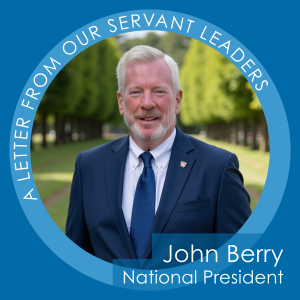
Merry Christmas and may God Bless you and your family,
John